September 03, 2013

Uncrowning The Customer

In the Dublin of my boyhood, the Superquinn brand was truly a household name. Particularly in our household, where my mother, who knew the value of things, repeatedly chose to turn left out of our home near the Children's Hospital to shop in her favourite store in Walkinstown, rather than right to the nearby Crumlin Shopping Centre with its shiny new Quinnsworth (now Tesco).

I've written previously in Open-Heart Branding (When It All Adds Up) of the extraordinary retail brand that Feargal Quinn built in the sixties and seventies, and his amazing feat of persuading cash-strapped housewives to see the real value in shopping at his stores, where great food, innovative offers and exceptional service were available at a premium. Feargal had so much faith in his own offer that he knew he didn't need to compete on price.

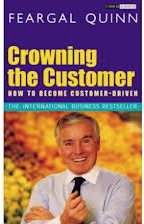
As an artisan brand-builder myself, and a keen student of the great brands, I read and re-read his book Crowning The Customer, in which he describes the simple but difficult task of putting the customer first, and of crafting an offer laden with value which can be readily appreciated by the customer. And by appreciated, I mean ready to pay for it, and pay handsomely too.

And in these difficult economic circumstances, I often use the example of the Superquinn of my boyhood to inspire those clients of mine who are inclined to lose faith in the quality of their own offer in the mistaken belief that customers cannot appreciate the value in it. If Feargal Quinn could persuade the hard-pressed but savvy housewives of seventies' Dublin to spend their money wisely with him, I say, then surely there's a place in your marketplace for products and services that crown the customer in much the same way.

And yet I was unsurprised by last month's news (Superquinn Brand To Be Dropped By New Owners) that recent buyers Musgraves plan to rebrand the 24 Superquinn stores as Supervalu.

Unsurprised, because I believe that Superquinn, having crowned the customer triumphantly throughout the seventies and eighties, lost faith in the value of its own offer when the competition upped the ante in the nineties, and surreptitiously stole back the customer's golden crown to replace it with a shiny but copper-based replica, the classic fool's gold.

I trace it back to an apparently innocuous event, sometime in the late nineties, at the entrance to our local store. It probably seemed like a good idea at the time, but it heralded the beginning of the end of the great Superquinn brand. There it stood, a simple supermarket trolley, packed with the mix of products you'd typically find on a weekly household shopping list. Attached to it was the legend proclaiming that the cost of the products in this Superquinn trolley was as cheap as those to be found in its Dunnes or Tesco equivalents.

Now, I knew that this was probably true in this case - I had no doubt the local shop-manager had carefully researched and assembled this particular trolley-load of goods so that it would bear comparison - but that wasn't the point. I knew that it wasn't true in general.

In one clumsy gesture, Superquinn had swiped the crown from the customer. Remember that Feargal Quinn had always appealed to the intelligence of the savvy shopper, and in doing so had created a very grown-up brand. No cheap tricks for Feargal. My mother knew that she was being charged a premium, and she was happy to pay it. The last thing the savvy customer needs is to have their intelligence and loyalty insulted.  Because, whilst it was almost certainly true that the particular trolley-load in question was as cheap as its competitors, the customer knew that shopping in Superquinn once came with a bold premium attached: a premium on great food, innovative products and exceptional service that they had agreed was worth paying for.

Superquinn, which had achieved the near-impossible task of creating value in a cash-poor economy, managed to destroy that same value in the cash-rich (and growing richer) society of late nineties' Ireland. Fool's gold indeed.

They may have lured in a few carpet-baggers on the heels of their sleight-of-hand, and perhaps they turned a quick profit, but from then on the Superquinn brand lost its lustre and became just one of many retailers hawking their wares to a critical customer, and competing on price.

And so I was unsurprised to see that the brand's new owners don't see the value in retaining the Superquinn name. In many ways, their own Supervalu brand, which champions local producers and personal service, had already stolen a march on a brand that lost faith in its own values, and the value it offered its customers as a result.

Others too have taken a lead from Crowning The Customer, and Irish retail has a number of young pretenders vying for the Superquinn crown. But as a child of the seventies, I still think it's a terrible pity that one of the few Irish brands from that time that could truly claim greatness, has fallen from grace and become largely irrelevant to the customer of today.

Over To You: Do you think it's possible to create a brand today that doesn't compete on price? Do any other Irish brands (emerging or established) come to mind?

January 09, 2013

Win, Lose Or Draw: The Power Of Branding

While dawdling over a cup of coffee at a favourite restaurant on New Year's Day, I couldn't help watching the football updates on one of the large screens behind the counter.

Naturally enough, I was drawn towards those matches featuring either my own team (which is labouring mid-table) or the big teams at the top of the league.

I say 'my team' despite the fact that I'm not a Liverpudlian, nor have I ever been to Anfield. Still, Liverpool has been my team since a fateful day back in the early '70's, when the first collector's card I pulled from the packet outside the local sweetshop featured the imposing figure of one Tommy Smith who, my pal informed me, was captain of Liverpool and something of a legend. That was enough for me: Tommy Smith was to be my hero and Liverpool my team.

And so, I've followed them since then, and as you'd expect, I look to see how they're doing whenever there are reports on football. But perhaps more surprisingly on the first day of the year, I also found myself rooting for certain teams playing out fixtures that were unlikely to have anything more than mid-table outcomes. And really caring about the results!

I wanted to see Reading thump Tottenham (although they didn't), and Southampton frustrate Arsenal (which they did). I was sorry to see Norwich City trailing to West Ham United, and even sorrier to see Stoke City and Wigan Athletic suffering a mauling at the hands of the two Manchester giants. I was pleased to see Swansea City and Aston Villa play out a draw, as I didn't like to see either lose. In short, I found I had a stake in every one of the fixtures being played that afternoon.

As I lingered there, I was surprised at the strength of my feeling for and against a real mixed bag of teams from places that I've never been and, in many cases, know little about.  To my astonishment, I realised for the first time that I'd developed a quite complex set of allegiances based on little more than a passing knowledge of games being played hundreds of miles away in another country.

Of course, sometimes it was a fairly typical wish to see the giant slain by the journeyman; even better to watch the bitter rival of my team fall foul of the gallant underdog. But there was more to it than that. Unknown to myself, I had developed a fairly sophisticated hierarchy of allegiances, which enabled me - or even obliged me - to back the outcome of a game almost as though I had some real vested interest.

And it struck me that as a customer I'm much the same. I rarely feel indifferent to any of the products or services on offer in the marketplace. I want to see some succeed and some fail. I care about those brands for reasons that are sometimes clear and sometimes beyond me, the equivalent of my randomly opening a packet of football cards and choosing the first team to appear. My job, of course, requires me to make some sense of the allegiances of customers, but I still marvelled at how relatively complex my set of footballing loyalties had become, almost without my noticing.

Why do I prefer an unromantic team such as Reading over their stylish rivals Tottenham? On another day, I'd happily see Tottenham overcome Manchester United (even better if they achieved the unthinkable and thrashed them) and Reading beaten by Swansea. How do I tease out the not-so-obvious fealties that I have towards the twenty-two teams who make up the English Premier League, not to mention the many others dotted throughout the other European leagues who either attract or repel me in the same way? Real versus Barca, Celtic against Rangers, and so on...

In a sense, this is the task facing the business-owner, who must also try to make sense of the tangle of loyalties at work in the marketplace. Underestimating where the customer's loyalties lie leaves the shopkeeper vulnerable to the apparent vagaries of the economy (pick a card, any card), rather than master of their own fate.

For just as surely as I can trace my own affections for Reading back to a time when the team featured a number of Irish players, and my disdain for Tottenham back to their treatment of various managers who I admired, the business-owner can and must trace the likes and dislikes at work in their marketplace.

Otherwise, they'll miss the opportunities at play in their business, just as certainly as the casual observer might have missed the depth of feeling just below the surface of the man dawdling over his coffee in a restaurant on New Year's Day.

Over To You: What do you think? How important is brand loyalty to whether you win, lose or draw in your market?

September 11, 2012

The Bare Necessities Of Brand Loyalty

Over the past few months, I've become something of a regular at The Bald Barista in Dublin. It's a handy place to prepare for my nearby meeting, the staff there are very friendly and the coffee's pretty good too.

But, despite my growing habit, I resisted their offer of a loyalty card, as I didn't want to add to the clutter in my wallet. Meaning I missed out on an occasional complimentary coffee and the Bald Barista missed out on my becoming part of their loyal customer group.

That's until I noticed someone ahead of me in the queue retrieving their card from a small rolodex behind the counter and handing it to the barista. She endorsed it, then returned it to the customer, who in turn replaced it in the rolodex. Problem solved!

When it came to my turn, I said 'yes' to the usual offer of a loyalty card, quickly wrote my name at the top, and added it to the rolodex under 'T'. All the while, feeling strangely pleased with myself as I did so.

As I sipped my coffee, I compared this apparently unsophisticated system with those employed by the larger coffee chains, who have typically adopted electronic technologies to track custom and keep coffee drinkers sweet.

And I concluded that, whilst the Bald Barista's system was a little cumbersome, and technically very old-fashioned, there was something quite appealing about knowing that 'my card' sat behind the counter (rather than in my wallet) waiting for my next visit. Something very personal too.

The more I thought about it, the more ingenious this unsophisticated system seemed to me. In making it personal, the Bald Barista was getting much closer to the heart of loyalty than many of his more technologically advanced competitors. For me, the simple knowledge that my card, with my name scrawled on it, enjoyed pride of place in the rolodex behind the counter, made the loyalty card much more than just a system to rack up points towards a free beverage. Instead, I felt myself to be a card-carrying member of the Bald Barista community of coffee-drinkers, something that the shiny plastic systems on offer elsewhere had failed to do.

I'm unlikely to be alone in feeling this way. Sometimes, the simpler approach is best, and brand-owners are better advised to choose those systems that bring them closer to their customer rather than just enable them to manage a process more efficiently.

Now, I'm quite sure that economics played a part in the Bald Barista's decision to stick with a 'pen and paper' system, and I'm fairly sure the system isn't fool-proof, but for me the unadorned simplicity of an approach which puts you right at the heart of a business is irresistible.

Over To You: What do you think? Have you experienced slick loyalty systems that leave you feeling cold when compared with those that offer something of the human touch?

July 28, 2012

Faster, Higher, Stronger...Or Simply More Effective

"To us they're Olympians. But to their moms, they'll always be kids"

Fast Company recently invited us to "find out which brands have already ascended the podium in the freestyle advertising events in London' and included ads from the likes of Nike, Paddy Power and Lego in their top twelve.

Whilst many of these ads are very powerful, the winner for me has been one from Proctor and Gamble that didn't even make it onto Fast Company's very crowded podium. I suspect the magazine's Olympic judges have been swayed more by the glamour and attitude of some of these ads rather than by the powerful insight that drives the narrative of Proctor and Gamble's Olympic Kids 2012.

The idea behind the ad is very simple but effective. It features a number of children participating in an Olympic Games, whilst their mothers look on. At the end, it emerges that all along we've been watching grown athletes in action through the eyes of their mothers. The brilliant punchline, "To us they're Olympians. But to their moms, they'll always be kids' goes to the very heart of the relationship between a mother and her children and reminds us that no matter how grown up we are, we are still our mother's children.

(Having just turned forty-seven, I see this for myself when my mother bristles at how broadcaster George Hook "is always interrupting you" during our Kickstart Your Business feature on Newstalk every Saturday morning. That may be George's style with guests and co-presenters, and part of his great appeal to listeners like me who enjoy his often-combative style, but my mother continues to look out for her little boy!).

The Olympian kids is one of a series of ads that cleverly links Proctor and Gamble and its products to the Games; another salutes the mothers who work tirelessly behind the scenes to support their children in their efforts to reach the top of their particular game. Perhaps the only mis-step in the ad is the US-reference to 'moms' rather than 'mums', which is likely to jar just a little in this part of the world. But I'm nit-picking.

It seems to me that by telling a very simple story very well and touching the hearts of mothers in this way, Proctor and Gamble are much more likely to see a return in terms of loyalty and sales, than those other ads which are more about the hard-nosed, competitive side of the games in my view.

What do you think? Is this little boy too dewy-eyed at the shameless appeal of a multinational giant to the heart-strings, or is an ad that speaks to a mother in such a powerful way likely to reap the benefits on the supermarket shelves?

July 02, 2012

Too Good To Be True


It must be the horse-trader in me but I like the idea of a bargain as much as the next man. And so I find it difficult to ignore the offers that come my way courtesy of the various online dealers that negotiate rates with hotels, restaurants and other providers on my behalf. But that same horse-trader sometimes wonders how so many of those businesses can afford to give away the value they offer and yet turn a profit.

And, of course, so many of them can't. Two recent experiences showed up the difference that a fine margin and no margin at all can make.

In the first, I took up an offer from a dentist, which included an examination, x-rays and clean and polish. My visit was as much a pleasure as any visit to the dentist can be. I was greeted warmly, quizzed professionally on the details of my health, and expertly examined and treated. The dentist then took an extra few minutes to review my x-rays with me, before producing an outsized toothbrush and set of teeth in order to demonstrate to me the correct way to brush my teeth. He had rightly gathered that I had been cleaning my teeth in a certain way for many years, and showed me a different method which he assured me would be just as effective without being quite so hard in terms of wear and tear.  I left his surgery intent on giving him my business next time I needed to make a dental appointment.

My second experience couldn't have been more different. I booked a meal at a restaurant that offered a menu at a price that seemed to me to be too good to be true. And so it proved. I arrived with a friend for our meal and was greeted by a surly waiter who showed us to a section reserved for those using coupons. We were then given a menu devised for those dining on the special offer. Determined to make a point, it seemed, our waiter then clumsily reminded us that our choice was limited to the items on that menu.

It didn't stop there. Throughout the evening, our waiting staff made it very clear that they thought we were cheapskates, nuisance customers who were more trouble than we were worth. In 'coupon ghetto', service was slow and churlish, whilst elsewhere guests enjoyed something closer to friendly and attentive service. Closer to, but not quite there, because the atmosphere on the wrong side of the tracks had clearly poisoned the atmosphere in that particular restaurant and an unpleasant air of resentment lingered like a bad smell from the kitchen.

What a difference a fine margin and no margin at all can make. At the dentist, it was evident to me that he had done his sums properly and made sure it was worth his while to examine and treat me at the special rate. His service was brisk but thorough and I had no sense at any stage that I was an unwelcome patient.  His counterpart at the restaurant obviously hadn't crunched the numbers with the same diligence, and me and my friend were clearly bad guests as far the restauranteur and his colleagues were concerned.

Of course, it's not just coupon deals that can be too good to be true. Time was when the words 'bargain' and 'deal' meant that both buyer and seller benefitted from the arrangement. That's often no longer the case. Horse-traders of old were mindful that each party to a deal had to 'leave something on the table for the other'. Otherwise, the bargain was bad for business.

It's not just sellers who need to be aware of this. As buyers, we should resist the urge to choose cut-price rates that clearly leave no value on the table for the seller. if it seems to good to be true, then it usually is. But, as always, responsibility ultimately lies with the seller. When we go to market, we must ensure that the bargains we strike are good for business; otherwise, we serve both ourselves and our customers badly.

And that's a bad deal for everyone.

Over To You: What do you think? Have you shook hands on a deal that was just too good to be true and regretted it?