November 12, 2013

To Market, To Market, To Buy A Fat Pig

Bringing the Market Place to Life Online

There is something romantic and earthy about the traditional market place where we get to meet producers and stallholders, each one good-naturedly vying for our attention as we meander through the hustle and bustle, savouring the competing sounds, sights and smells.

On yesterday's ‘Kickstart Your Business’ on Newstalk, we were introduced to an exciting new business MarketDirect.ie. Set up by Keith McGuigan, Marketdirect.ie gives people the opportunity to buy goods from farmer’s market all over Ireland and provides a platform for local market producers and stallholders to reach a wider audience.

One a Penny, Two a Penny, Hot Cross Buns

Like any business and website starting out, MarketDirect.ie is a work in progress but already their visual identity is spot on. What is missing from the website is the sense of personality and character we associate with stallholders and their produce at local markets.

Home Again, Home Again, Jiggity Jig

We suggested Keith first look at how customers choose to buy from a real market and then host that interactive experience for them online. For example, the buzz of the local market could be better captured with vibrant and eye-catching photography and the personality of the market could come to life with videos of stallholders pitching their wares (rather than just talking to camera).

Over to You

How do you suggest that Keith and his team might better go to market? Whether you listened to the show and / or read this blogpost, we’d love to hear what you think.

November 05, 2013

A Moment On The Lips: How Hot Chocolate Goes To Your Bottom Line

A Guest Post from Anne Tannam, Brand Manager at Islandbridge Brand Development

Earlier in the week, I was sitting in the foyer of a hotel close to Baggot Street waiting for a client to arrive. There was the usual mix of people sitting on the comfortable couches; tourists poring over city-break brochures, business people glued to their laptops, and inquisitive me: people-watching to pass the time.

Looking around, I noticed that though it was a Tuesday and very close to lunchtime, the restaurant beside me held only a handful of customers who, by and large, were eating on their own and in silence.

Hey, Is There Anyone Out There?

As my client had texted ahead to say she’d be another ten minutes, I decided to treat myself to a hot chocolate to hold off the hunger pangs until after the meeting. I tried to catch the eye of a member of staff to order but they all seemed distracted, moving quickly across the foyer with other business to attend to.

I glanced around at my fellow foyer visitors and saw most of them were also sitting there without drink or food and, more tellingly, without any interaction or banter with staff.

A Missed Opportunity

My client then arrived, declined the offer of a drink and we settled down to have our meeting. Afterwards, though hungry, I wasn’t tempted to stay for a bite of lunch and instead, nipped into the deli next door and ordered a sandwich to go (the hot chocolate would have to wait for another day).

As I cycled back to the office with both my helmet and brand manager hat on, I thought about my experience at the hotel and couldn’t help think that they had missed out on a very important opportunity. 

In money and bottom-line thinking, it probably doesn’t seem like much; eight to ten euros on a hot chocolate and a sandwich but the opportunity was so much bigger than that.

When You Say Nothing At All

Simply put, the hotel failed to invite me to become a customer. I was just someone sitting in the foyer of their hotel for an hour. During that time, there was no eye contact, no invitation to purchase and no attempt to establish the type of business relationship that might prompt me to return again or to recommend the hotel to others.

In short, despite the very comfy couch and the soft music playing in the background, I did not feel like a welcome guest. And that has to be the aim of all those working in the hospitality sector and the reason four billion euros was spent by tourists in Ireland in 2012. 

And I’m sure some of it was spent on hot chocolate!.

A Moment On The Lips

Bottom line is, as business owners and managers we must always remember that people are not just buying a product or service from us; they are buying an experience. We are social animals by nature and personal interaction with your customers, coupled with a clear offer and proposition, is likely to yield both far greater results and profit margins for your business and to create satisfied customers who feel welcome and appreciated and therefore much more likely to return again and again to relive the experience.

What Do You Think? What are the opportunities in your business both to make a sale and create a customer, who's likely to return again and recommend you to others?

September 03, 2013

Uncrowning The Customer

In the Dublin of my boyhood, the Superquinn brand was truly a household name. Particularly in our household, where my mother, who knew the value of things, repeatedly chose to turn left out of our home near the Children's Hospital to shop in her favourite store in Walkinstown, rather than right to the nearby Crumlin Shopping Centre with its shiny new Quinnsworth (now Tesco).

I've written previously in Open-Heart Branding (When It All Adds Up) of the extraordinary retail brand that Feargal Quinn built in the sixties and seventies, and his amazing feat of persuading cash-strapped housewives to see the real value in shopping at his stores, where great food, innovative offers and exceptional service were available at a premium. Feargal had so much faith in his own offer that he knew he didn't need to compete on price.

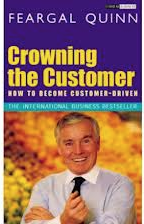
As an artisan brand-builder myself, and a keen student of the great brands, I read and re-read his book Crowning The Customer, in which he describes the simple but difficult task of putting the customer first, and of crafting an offer laden with value which can be readily appreciated by the customer. And by appreciated, I mean ready to pay for it, and pay handsomely too.

And in these difficult economic circumstances, I often use the example of the Superquinn of my boyhood to inspire those clients of mine who are inclined to lose faith in the quality of their own offer in the mistaken belief that customers cannot appreciate the value in it. If Feargal Quinn could persuade the hard-pressed but savvy housewives of seventies' Dublin to spend their money wisely with him, I say, then surely there's a place in your marketplace for products and services that crown the customer in much the same way.

And yet I was unsurprised by last month's news (Superquinn Brand To Be Dropped By New Owners) that recent buyers Musgraves plan to rebrand the 24 Superquinn stores as Supervalu.

Unsurprised, because I believe that Superquinn, having crowned the customer triumphantly throughout the seventies and eighties, lost faith in the value of its own offer when the competition upped the ante in the nineties, and surreptitiously stole back the customer's golden crown to replace it with a shiny but copper-based replica, the classic fool's gold.

I trace it back to an apparently innocuous event, sometime in the late nineties, at the entrance to our local store. It probably seemed like a good idea at the time, but it heralded the beginning of the end of the great Superquinn brand. There it stood, a simple supermarket trolley, packed with the mix of products you'd typically find on a weekly household shopping list. Attached to it was the legend proclaiming that the cost of the products in this Superquinn trolley was as cheap as those to be found in its Dunnes or Tesco equivalents.

Now, I knew that this was probably true in this case - I had no doubt the local shop-manager had carefully researched and assembled this particular trolley-load of goods so that it would bear comparison - but that wasn't the point. I knew that it wasn't true in general.

In one clumsy gesture, Superquinn had swiped the crown from the customer. Remember that Feargal Quinn had always appealed to the intelligence of the savvy shopper, and in doing so had created a very grown-up brand. No cheap tricks for Feargal. My mother knew that she was being charged a premium, and she was happy to pay it. The last thing the savvy customer needs is to have their intelligence and loyalty insulted.  Because, whilst it was almost certainly true that the particular trolley-load in question was as cheap as its competitors, the customer knew that shopping in Superquinn once came with a bold premium attached: a premium on great food, innovative products and exceptional service that they had agreed was worth paying for.

Superquinn, which had achieved the near-impossible task of creating value in a cash-poor economy, managed to destroy that same value in the cash-rich (and growing richer) society of late nineties' Ireland. Fool's gold indeed.

They may have lured in a few carpet-baggers on the heels of their sleight-of-hand, and perhaps they turned a quick profit, but from then on the Superquinn brand lost its lustre and became just one of many retailers hawking their wares to a critical customer, and competing on price.

And so I was unsurprised to see that the brand's new owners don't see the value in retaining the Superquinn name. In many ways, their own Supervalu brand, which champions local producers and personal service, had already stolen a march on a brand that lost faith in its own values, and the value it offered its customers as a result.

Others too have taken a lead from Crowning The Customer, and Irish retail has a number of young pretenders vying for the Superquinn crown. But as a child of the seventies, I still think it's a terrible pity that one of the few Irish brands from that time that could truly claim greatness, has fallen from grace and become largely irrelevant to the customer of today.

Over To You: Do you think it's possible to create a brand today that doesn't compete on price? Do any other Irish brands (emerging or established) come to mind?

January 09, 2013

Win, Lose Or Draw: The Power Of Branding

While dawdling over a cup of coffee at a favourite restaurant on New Year's Day, I couldn't help watching the football updates on one of the large screens behind the counter.

Naturally enough, I was drawn towards those matches featuring either my own team (which is labouring mid-table) or the big teams at the top of the league.

I say 'my team' despite the fact that I'm not a Liverpudlian, nor have I ever been to Anfield. Still, Liverpool has been my team since a fateful day back in the early '70's, when the first collector's card I pulled from the packet outside the local sweetshop featured the imposing figure of one Tommy Smith who, my pal informed me, was captain of Liverpool and something of a legend. That was enough for me: Tommy Smith was to be my hero and Liverpool my team.

And so, I've followed them since then, and as you'd expect, I look to see how they're doing whenever there are reports on football. But perhaps more surprisingly on the first day of the year, I also found myself rooting for certain teams playing out fixtures that were unlikely to have anything more than mid-table outcomes. And really caring about the results!

I wanted to see Reading thump Tottenham (although they didn't), and Southampton frustrate Arsenal (which they did). I was sorry to see Norwich City trailing to West Ham United, and even sorrier to see Stoke City and Wigan Athletic suffering a mauling at the hands of the two Manchester giants. I was pleased to see Swansea City and Aston Villa play out a draw, as I didn't like to see either lose. In short, I found I had a stake in every one of the fixtures being played that afternoon.

As I lingered there, I was surprised at the strength of my feeling for and against a real mixed bag of teams from places that I've never been and, in many cases, know little about.  To my astonishment, I realised for the first time that I'd developed a quite complex set of allegiances based on little more than a passing knowledge of games being played hundreds of miles away in another country.

Of course, sometimes it was a fairly typical wish to see the giant slain by the journeyman; even better to watch the bitter rival of my team fall foul of the gallant underdog. But there was more to it than that. Unknown to myself, I had developed a fairly sophisticated hierarchy of allegiances, which enabled me - or even obliged me - to back the outcome of a game almost as though I had some real vested interest.

And it struck me that as a customer I'm much the same. I rarely feel indifferent to any of the products or services on offer in the marketplace. I want to see some succeed and some fail. I care about those brands for reasons that are sometimes clear and sometimes beyond me, the equivalent of my randomly opening a packet of football cards and choosing the first team to appear. My job, of course, requires me to make some sense of the allegiances of customers, but I still marvelled at how relatively complex my set of footballing loyalties had become, almost without my noticing.

Why do I prefer an unromantic team such as Reading over their stylish rivals Tottenham? On another day, I'd happily see Tottenham overcome Manchester United (even better if they achieved the unthinkable and thrashed them) and Reading beaten by Swansea. How do I tease out the not-so-obvious fealties that I have towards the twenty-two teams who make up the English Premier League, not to mention the many others dotted throughout the other European leagues who either attract or repel me in the same way? Real versus Barca, Celtic against Rangers, and so on...

In a sense, this is the task facing the business-owner, who must also try to make sense of the tangle of loyalties at work in the marketplace. Underestimating where the customer's loyalties lie leaves the shopkeeper vulnerable to the apparent vagaries of the economy (pick a card, any card), rather than master of their own fate.

For just as surely as I can trace my own affections for Reading back to a time when the team featured a number of Irish players, and my disdain for Tottenham back to their treatment of various managers who I admired, the business-owner can and must trace the likes and dislikes at work in their marketplace.

Otherwise, they'll miss the opportunities at play in their business, just as certainly as the casual observer might have missed the depth of feeling just below the surface of the man dawdling over his coffee in a restaurant on New Year's Day.

Over To You: What do you think? How important is brand loyalty to whether you win, lose or draw in your market?

September 11, 2012

The Bare Necessities Of Brand Loyalty

Over the past few months, I've become something of a regular at The Bald Barista in Dublin. It's a handy place to prepare for my nearby meeting, the staff there are very friendly and the coffee's pretty good too.

But, despite my growing habit, I resisted their offer of a loyalty card, as I didn't want to add to the clutter in my wallet. Meaning I missed out on an occasional complimentary coffee and the Bald Barista missed out on my becoming part of their loyal customer group.

That's until I noticed someone ahead of me in the queue retrieving their card from a small rolodex behind the counter and handing it to the barista. She endorsed it, then returned it to the customer, who in turn replaced it in the rolodex. Problem solved!

When it came to my turn, I said 'yes' to the usual offer of a loyalty card, quickly wrote my name at the top, and added it to the rolodex under 'T'. All the while, feeling strangely pleased with myself as I did so.

As I sipped my coffee, I compared this apparently unsophisticated system with those employed by the larger coffee chains, who have typically adopted electronic technologies to track custom and keep coffee drinkers sweet.

And I concluded that, whilst the Bald Barista's system was a little cumbersome, and technically very old-fashioned, there was something quite appealing about knowing that 'my card' sat behind the counter (rather than in my wallet) waiting for my next visit. Something very personal too.

The more I thought about it, the more ingenious this unsophisticated system seemed to me. In making it personal, the Bald Barista was getting much closer to the heart of loyalty than many of his more technologically advanced competitors. For me, the simple knowledge that my card, with my name scrawled on it, enjoyed pride of place in the rolodex behind the counter, made the loyalty card much more than just a system to rack up points towards a free beverage. Instead, I felt myself to be a card-carrying member of the Bald Barista community of coffee-drinkers, something that the shiny plastic systems on offer elsewhere had failed to do.

I'm unlikely to be alone in feeling this way. Sometimes, the simpler approach is best, and brand-owners are better advised to choose those systems that bring them closer to their customer rather than just enable them to manage a process more efficiently.

Now, I'm quite sure that economics played a part in the Bald Barista's decision to stick with a 'pen and paper' system, and I'm fairly sure the system isn't fool-proof, but for me the unadorned simplicity of an approach which puts you right at the heart of a business is irresistible.

Over To You: What do you think? Have you experienced slick loyalty systems that leave you feeling cold when compared with those that offer something of the human touch?